
Category: News

  • Lived Expertise Network For Systems Change (LENS) Launches To Advance A New Vision: Systems Transformation Led By Living Expertise

    Lived Expertise Network For Systems Change (LENS) Launches To Advance A New Vision: Systems Transformation Led By Living Expertise

    Boston, MA (July 30, 2026) — Lived Expertise Network for Systems Change (LENS), formerly Massachusetts CASA Association, today announced its evolution into an organization dedicated to transforming systems through lived expertise and advancing thewell-being of children, youth, families, and communities.

    For nearly a decade, LENS leaders have worked alongside children, youth, families, advocates, and communities to strengthen child and family well-being. Through that work, they have recognized that meaningful change requires more than supporting individuals within existing systems. It requires transforming the narratives, policies, practices, and structures that shape
    people’s lives.

    Lived expertise is the knowledge, wisdom, and leadership gained through directly navigating systems and experiencing their impact firsthand. For too long, people with lived expertise have been viewed through narratives of risk, need, or deficit rather than recognized as experts with essential insight into how systems function and what must change. Lived expertise reveals how
    systems operate in practice, where they fall short, the harm and inequities they can create, and the solutions needed to transform them.

    The evolution into LENS represents a bold commitment to a long-held belief: people most impacted by systems must have meaningful influence and leadership in shaping their future. LENS was built on the belief that lived expertise was never the missing piece. The missing piece was whether systems were willing to recognize its power, trust its leadership, and create
    meaningful pathways for it to shape change.

    “Organizations must be willing to listen deeply, understand deeply, and respond when communities tell us what they are experiencing, what they need, and what must change,” said Charles Lerner, Executive Director of LENS and a former foster youth. “I know firsthand what it feels like to be a child impacted by systems and to not have someone recognize the harm or step
    in when it mattered most. But I also know the wisdom, strength, and leadership that can come from those experiences. Years later, I found myself advocating for the rights and protections of children in foster care. This work has never been only about foster care. It is about strengthening families before they reach a crisis and creating systems rooted in dignity, compassion, and humanity so that more children can grow up safely with the people who love them. That’s the future we’re building at LENS.”

    Why LENS, Why Now
    Across communities, people with direct experience navigating complex systems have too often been asked to share their perspectives without meaningful opportunities to influence decisions, shape solutions, or lead transformation. Their experiences have been treated as information to collect, problems to manage, or risks to mitigate rather than expertise to value and
    leadership to trust.

    LENS exists to change that dynamic.

    The need for a different approach is not abstract. Systems shape all of our lives, and across communities, people are experiencing systems that too often fall short. Families struggle to navigate health care systems that do not always center their needs, experiences, or voices. Students and parents encounter education systems that do not meet the needs of every child.
    Communities experience the consequences of housing instability and economic insecurity, while public systems invest significant resources trying to address challenges that too often persist.

    People with lived expertise often understand both the harm created by existing systems and what must change to create better solutions. The question is not whether communities have the knowledge, wisdom, and leadership needed to help create change. The question is whether systems are willing to listen, trust, and share power with the people who know them best. “The future of systems transformation requires moving beyond inviting people into the room,” said Lerner. “It requires creating pathways for people to have meaningful influence, authority, and power.”

    How LENS Advances Systems Transformation
    LENS advances systems transformation by creating pathways for lived expertise to shape how challenges are understood, solutions are developed, and change is driven.

    Through six interconnected areas of work: Lived Expertise Leadership & Power Building, Public Education & Narrative Change, Systems Learning & Innovation, Workforce & Practice Transformation, Community Collaboration & Systems Alignment, and Policy & Systems Change, LENS works alongside communities, organizations, and systems to build collective power, challenge harmful narratives, strengthen practice, generate community-informed solutions, align efforts, and advance policies that improve the systems shaping people’s lives.

    Together, these efforts translate lived expertise into collective influence, ensuring that people with firsthand experience are not only informing change but helping define, shape, and lead it. “What drew me to LENS was their courage to stand with families and to center the voices of those who have been pushed to the margins for generations,” said Tatiana Rodriguez, Founder and Executive Director of Family Matters 1st Inc. and a LENS lived expertise partner. “LENS recognizes that lived expertise isn’t a deficit; it’s truth. It’s the evidence of what families have survived, and it cannot be erased or gaslit. For too long, systems have spoken about families instead of listening to them. LENS is helping change that.”

    LENS is building a future where lived expertise helps shape the systems that shape our lives. To learn more about LENS and opportunities to become involved, visit https://lexforchange.org/

    About LENS
    Lived Expertise Network for Systems Change (LENS) is a lived expertise-led organization advancing systems transformation by building collective power, elevating community wisdom, and creating pathways for people most impacted by systems to shape and lead change.

    Through lived expertise leadership, narrative change, systems learning, community collaboration, policy and systems change, and innovation, LENS works alongside communities, organizations, and public systems to advance more equitable, prevention-centered, and human-centered approaches that promote dignity, justice, and well-being
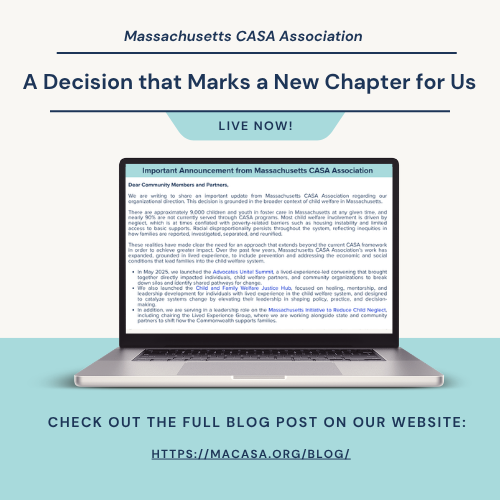

  • Important Announcement from Massachusetts CASA Association

    Important Announcement from Massachusetts CASA Association

    Dear Community Members and Partners,

    We are writing to share an important update from Massachusetts CASA Association regarding our organizational direction. This decision is grounded in the broader context of child welfare in Massachusetts.

    There are approximately 9,000 children and youth in foster care in Massachusetts at any given time, and nearly 90% are not currently served through CASA programs. Most child welfare involvement is driven by neglect, which is at times conflated with poverty-related barriers such as housing instability and limited access to basic supports. Racial disproportionality persists throughout the system, reflecting inequities in how families are reported, investigated, separated, and reunified.

    These realities have made clear the need for an approach that extends beyond the current CASA framework in order to achieve greater impact. Over the past few years, Massachusetts CASA Association’s work has expanded, grounded in lived experience, to include prevention and addressing the economic and social conditions that lead families into the child welfare system.

    • In May 2025, we launched the Advocates Unite! Summit, a lived-experience-led convening that brought together directly impacted individuals, child welfare partners, and community organizations to break down silos and identify shared pathways for change.
    • We also launched the Child and Family Welfare Justice Hub, focused on healing, mentorship, and leadership development for individuals with lived experience in the child welfare system, and designed to catalyze systems change by elevating their leadership in shaping policy, practice, and decision-making.
    • In addition, we are serving in a leadership role on the Massachusetts Initiative to Reduce Child Neglect, including chairing the Lived Experience Group, where we are working alongside state and community partners to shift how the Commonwealth supports families.

    Over time, a misalignment has become evident between our values and practice and those of Massachusetts’ local CASA programs. These differences have increasingly limited our ability to fully advance upstream, prevention-focused, equity- and justice-centered work. In some instances, our efforts have been viewed as outside CASA’s scope. We do not view them as outside CASA’s work; rather, we see them as foundational to improving outcomes for children and families.

    After careful consideration, Massachusetts CASA Association has decided to separate from CASA in order to align our vision, values, and strategy with this direction, effective July 1, 2026. CASA programs in Massachusetts will continue operating as usual and are not affected by this change. Massachusetts CASA Association is a separate nonprofit entity from the local programs across the state, and this change does not affect CASA volunteers or the services provided to children and youth.

    Our ongoing initiatives, including the Child and Family Welfare Justice Hub and our work with the Massachusetts Initiative to Reduce Child Neglect, will continue without interruption. We will adopt a new name and brand identity, while our commitment to our mission remains unchanged.

    We do not take this decision lightly. Our team brings deep experience with CASA, including service as Court Appointed Special Advocates (“CASAs”), professional roles within CASA organizations, lived experience in foster care, and, for one member, firsthand experience as a parent whose child was supported by a CASA volunteer. We recognize the important role these volunteers play in the lives of children.

    Building on the work and progress described above, we are refining a framework to guide our next chapter. This includes advancing upstream strategies that strengthen families before system involvement and centering directly impacted individuals in how we design programs, make decisions, and hold ourselves accountable. Through this work, we are contributing to a more compassionate, equitable, and socially just system—prioritizing family integrity over separation, reducing unnecessary system involvement, and supporting longterm stability for children and families. We will continue to prioritize advocacy for the safety and well-being of children and youth in foster care as a key area of our work.

    We are grateful for the support and shared commitment to our mission. We look forward to sharing updates and engaging with our community as this work moves forward.

    With appreciation and resolve,

    Massachusetts CASA Association Board & Staff

  • Driven by Justice: Our Responsibility, Commitment, and Passion

    Driven by Justice: Our Responsibility, Commitment, and Passion

    A Message from Our Leadership

    Justice is not aspirational for us—it is foundational, embedded in how we lead, how we build partnerships, and how we pursue systems change. It is also deeply personal. We refuse to be performative and recognize that meaningful systems change demands accountability to those most impacted, openness to learning, and the courage to confront hard truths. Over the past several years, we have positioned ourselves as catalysts for change within a child welfare system that profoundly shapes the lives of children and families. Despite its mandate to protect children and support families, the system too often falls short, leaving children unsafe, families unsupported, and communities disproportionately harmed.

    Massachusetts CASA updated its mission to advance better outcomes for families—not just children— impacted by the child welfare system, and to advocate for compassionate, equitable, and just policies and practices. We also established a very clear set of values we strive to uphold every day. When we fall short, we commit to acknowledging harm, taking responsibility, repairing wherever possible, and doing better. We see ourselves as justice seekers, working within a system shaped by some of the most abhorrent legacies in our country—legacies that still harm children, families, and communities. We center lived experience as expertise, with lived-experience leaders shaping decisions across the organization. We honor the dignity of every individual, lead with empathy, and confront systems that undermine human worth.

    Our commitment is not theoretical—it is tangible and measurable. Examples of our commitment in action include:

    • Led a first-of-its-kind statewide training on implicit bias and interrupting poverty for CASA staff and volunteers.
    • Piloted an equity- and justice-centered pre-service training for new volunteers that examined the history of the child welfare system, societal neglect, and the root causes of racial disproportionality and disparities, while challenging participants to reflect on their motivations. Trainings were led by multiple lived-experience experts with foster care experience.
    • Launched a first-ever, equity- and justice-driven statewide public awareness campaign across public radio and social media to address the conflation of poverty and neglect, and racial disproportionality in foster care. The campaign reached over 1.5 million people across New England, with targeted investment in BIPOC communities through Latino USA, Code Switch, and zip-code–specific social media outreach.
    • Convened Advocates Unite!, an inaugural statewide summit bringing together CASA volunteers, staff, and community partners to explore equity- and justice-centered approaches to child and family welfare. The summit featured a parent panel sharing their expertise on reimagining the system to better support families, while providing space to address systemic inequities, confront racial disproportionality, and amplify voices with lived experience.
    • Launched the Child and Family Welfare Justice Hub to center the voices of those most impacted—including current and former foster youth, parents who have had children involuntarily removed, and kinship caregivers. The Hub connects communities, creating a space where lived-experience experts can organize, heal, and lead. Its work includes equity- and justice-centered training, community-led dialogues, and work to influence policy and increase public awareness. By amplifying voices from neighborhoods to the State House, the Hub seeks to ignite collective action, model best practices, and advance policies and programs that strengthen families, enhance safety, and improve outcomes for children and youth.
    • Joined the Steering Committee of a Children’s Trust–led statewide initiative advancing family wellbeing across the Commonwealth. The initiative unites state agencies, family-serving organizations, individuals with lived experience, and community leaders to promote a community approach to child and family well-being. It challenges traditional definitions of neglect, the frequent conflation of neglect with poverty, and the framing of neglect as an individual parental deficit rather than a societal responsibility.

    This work is personal, grounded in our roots and shaped by our lived experience. For Julie, being born in El Salvador during the Civil War instilled a deep belief in grassroots movements and bold action. The Salvadoran people have spent decades fighting for social and economic justice through inclusive community organizing, offering a powerful model for building an alternative vision of society through coalition and struggle. Julie has continued to carry these principles throughout her life and career, shaped further by her personal experience in foster care in El Salvador and her eventual international and transracial adoption with her siblings. For Charles, his own time in foster care—and later advocating for his son within a system that often fails those it is meant to protect and care for—revealed firsthand the harm the system can inflict. He has witnessed generations of families caught in cycles of poverty, violence, and addiction—not for lack of love or commitment, but because systemic barriers and harm make these cycles extremely difficult to break. Together, our families, part of Black and Brown communities, inform and strengthen Massachusetts CASA’s mission and values, reinforcing our commitment to advancing equity and justice.

    Our systems of care, including our child welfare system, are at a point of reckoning. For the children and communities we serve, it is about survival, dignity, and the opportunity to thrive. We are acting with clarity in our purpose, conviction in our values, and authority grounded in lived experience to advance justice, equity, and dignity — and we will not waver.

    This message represents the views of Charles Lerner, Executive Director and Julie Louissaint, Deputy Director. They may or may not represent others associated with the CASA network.

    In community,

    Charles Lerner

    Executive Director

    Julie Louissain

    Deputy Director

  • Massachusetts CASA Launches Child and Family Welfare Justice Hub

    Massachusetts CASA Launches Child and Family Welfare Justice Hub

    Inspired by Lived Expertise, Driving a Vision for Systemic Change

    Boston, MA (Dec. 2, 2025) — Massachusetts CASA Association, the state office for Court Appointed Special Advocates (CASA), is proud to announce the launch of the Child and Family Welfare Justice Hub, a bold initiative of Massachusetts CASA (MA CASA) that operates independently of local CASA programs. The Hub is reimagining child welfare across the Commonwealth, building a system that is compassionate, equitable, justice-centered, and guided by those who know it best, to improve outcomes for children and families. By launching The Hub, MA CASA is committing to creating a space where lived experience shapes solutions, informs policy, and guides practice, and where community wisdom shapes the future of child welfare.

    Anyone interested in supporting this work, either through participation or financial contribution, can reach out to Julie Louissaint at [email protected].

    In Massachusetts, nearly 9,200 children are in foster care, and thousands more interact with the child welfare system each year. The majority of these cases involve neglect, which is often rooted in resource scarcity—including housing insecurity and income instability—that places immense strain on parents. This strain can manifest as mental illness or substance use, which are often cited as grounds for removing children. Many parents do not receive the support needed to prevent removal, and once children are removed, families are not provided the resources to address the original strain and related challenges that led to removal.

    The system also falls short in ensuring children’s care and safety. In Fiscal Year 2024, the Office of the Child Advocate reported 465 substantiated allegations of abuse or neglect in out-of-home placements, affecting 676 children. This is undoubtedly an underreporting of such incidents. Black and Latino/Hispanic children and LGBTQ+ youth are disproportionately represented, reflecting deeper inequities. These issues, among many, underscore the urgent need for systemic reform.

    The Hub reflects a simple, but powerful, principle: transformational change can only occur when those closest to the impact help define the solutions. The Hub will serve as a connective tissue across impacted communities, fostering a community-driven model where lived experience experts—including current and former foster youth, birth parents who have experienced involuntary child removal, and kinship caregivers such as grandparents raising grandchildren—can come together to organize, heal, and lead.

    The Hub’s work will include designing equity- and justice-centered training, facilitating community-led dialogues, and providing mentorship and leadership opportunities for individuals with lived experience. By amplifying voices from neighborhoods to the State House, The Hub

    seeks to ignite collective action, model best practices, and advance policies and programs that strengthen families, enhance safety, and improve outcomes for children and youth.

    “We are unwavering in our belief that true systems change is only possible when it’s led by those closest to the impact. Representation is necessary to dismantle long-standing systemic failures and improve outcomes for children and families. It is also essential for repairing harm and fostering healing,” said Charles Lerner, MA CASA Executive Director and former foster youth. Julie Louissaint, MA CASA Deputy Director, a transracial international adoptee from El Salvador, added, “Children and families who have been directly impacted by the foster care system deserve to be seen, heard, and centered.”

    About Massachusetts CASA

    Massachusetts CASA champions better outcomes for children and families in the child welfare system by supporting and developing CASA programs, and by advancing policies and practices that are compassionate, equitable, and justice-centered—ensuring families have the resources they need and that children’s best interests and well-being are always amplified.

    Massachusetts CASA is a 501(c)(3) tax-exempt nonprofit organization as defined in the Internal Revenue Code. Contributions to Massachusetts CASA are tax deductible to the fullest extent allowed by law.

    Learn more at www.macasa.org

  • Letter to the Community: Post-Summit Reflection

    Letter to the Community: Post-Summit Reflection

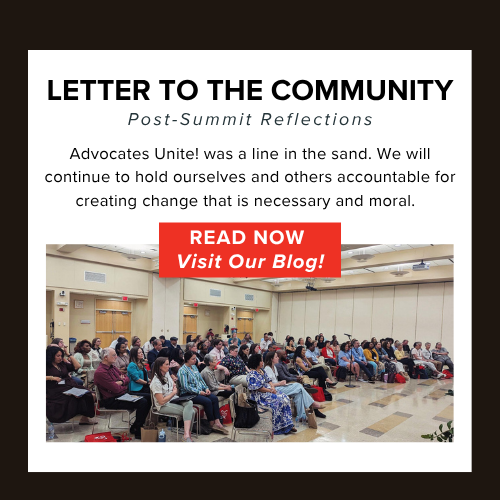
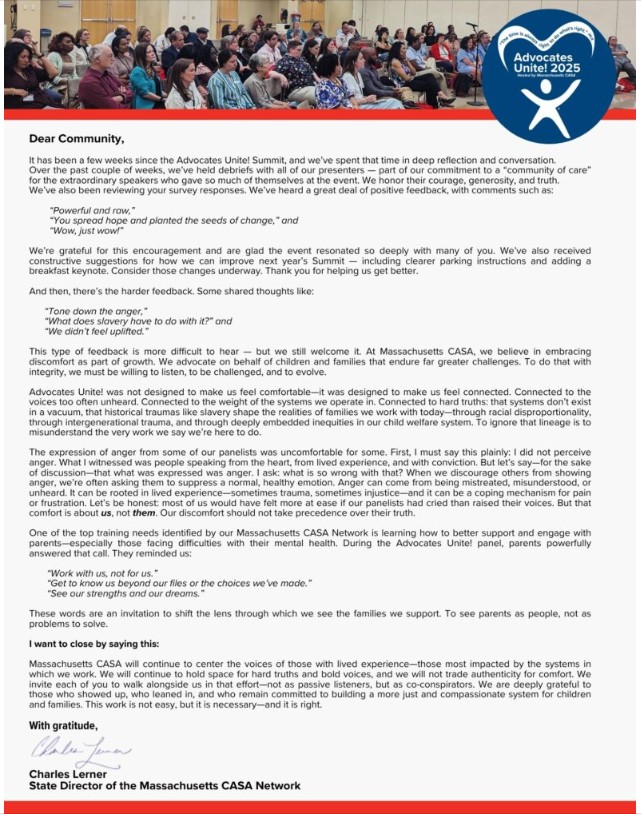
    We’re an organization led by dual experts (child welfare leaders who have also personally experienced the system firsthand and involuntarily). We will continue to center those in our lived experience community. We will continue to lead and engage in courageous conversations. We will continue to hold ourselves and others accountable for creating change that is necessary and moral. Advocates Unite! was a significant event and a line in the sand. As you can read in our post-Summit letter, it was not without consequences. However, we can endure them. The children and families we advocate on behalf of endure much much more.

  • Breaking the Cycle of Poverty But at What Cost?

    Breaking the Cycle of Poverty But at What Cost?

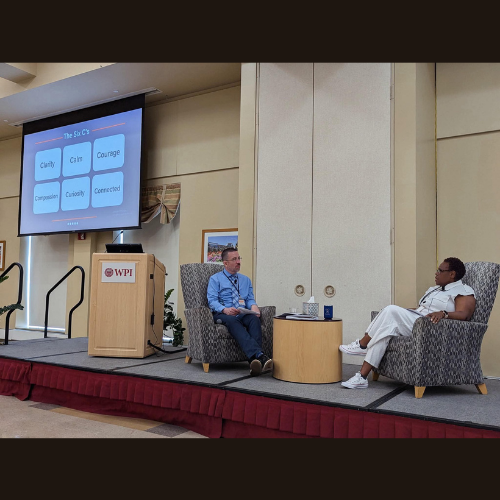
    Charles Lerner speaks on a powerful panel about his experiences living in poverty, being in foster care and how this shapes his work. The panel begins about 8 minutes in. Take a listen!

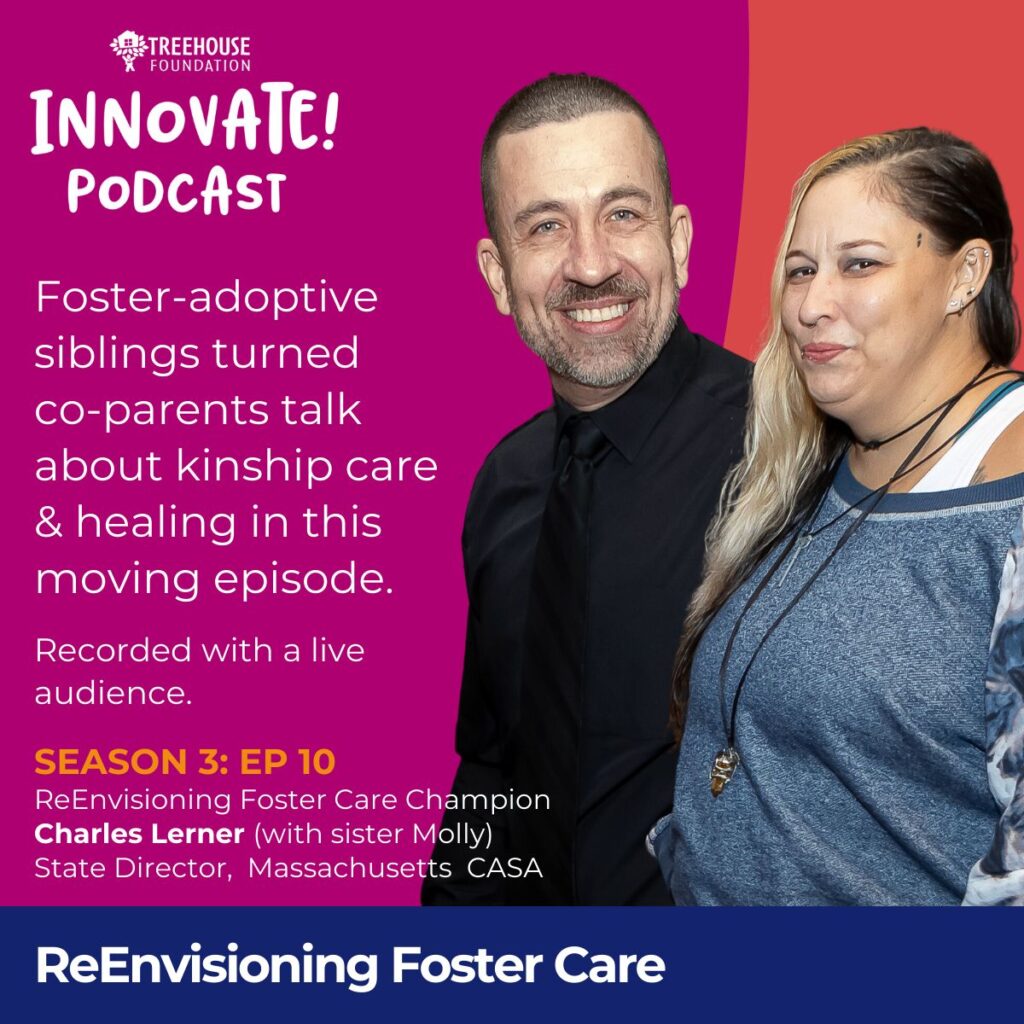
  • Recording this live podcast with my sister Molly was one of the most significant honors of my life. https://lnkd.in/ewQTx__k .

    Recording this live podcast with my sister Molly was one of the most significant honors of my life. https://lnkd.in/ewQTx__k .

    It was Molly’s first “public appearance”. It’s a very difficult podcast to hear because it’s raw, unfiltered, brutally honest, and highlights the worst of our child protection system. At the same time, I hope it also educates, uplifts, and honors voices too often silenced. I’m beyond proud of my sister. I’m appreciative of Angela Tucker who is a remarkable host. She’s extraordinarily compassionate and created a space that led to a very unique outcome. Thank you to Treehouse Foundation and Judy Cockerton for their vision and creating a platform for others to be heard.

    I’ve been part of the child welfare system for 48 years. I’m moving away from telling my story and moving towards ensuring that others have the opportunity to tell theirs. I’m moving away from explaining the realities of the system and moving torwards shifting those realities. As I say in the podcast, we are removing limbs from children and families in the child welfare system. When you remove limbs from a tree in the wrong way, you kill the tree. We’re destroying families, disproportionately BIPOC and/or those living in poverty. Join me in disrupting what has always been, repairing the harm, and getting it right. hashtag#getitright.

    Recording this live podcast with my sister Molly was one of the most significant honors of my life. https://lnkd.in/ewQTx__k .

    It was Molly’s first “public appearance”. It’s a very difficult podcast to hear because it’s raw, unfiltered, brutally honest, and highlights the worst of our child protection system. At the same time, I hope it also educates, uplifts, and honors voices too often silenced. I’m beyond proud of my sister. I’m appreciative of Angela Tucker who is a remarkable host. She’s extraordinarily compassionate and created a space that led to a very unique outcome. Thank you to Treehouse Foundation and Judy Cockerton for their vision and creating a platform for others to be heard.

    I’ve been part of the child welfare system for 48 years. I’m moving away from telling my story and moving towards ensuring that others have the opportunity to tell theirs. I’m moving away from explaining the realities of the system and moving torwards shifting those realities. As I say in the podcast, we are removing limbs from children and families in the child welfare system. When you remove limbs from a tree in the wrong way, you kill the tree. We’re destroying families, disproportionately BIPOC and/or those living in poverty. Join me in disrupting what has always been, repairing the harm, and getting it right. hashtag#getitright.

  • Foster Child Bill of Rights

    Foster Child Bill of Rights

    On behalf of the Commonwealth’s seven CASA programs, 700 volunteers, and close to 1,000 children we advocate on behalf of, I was proud to testify yesterday at the Statehouse on various foster care related bills. I specifically focused on Massachusetts moving forward on a Foster Child Bill of Rights. You can view my three minutes of testimony at about 1 hour and 27 minutes into the video. https://malegislature.gov/Events/Hearings/Detail/4705 My family’s history with the child welfare system goes back over 60 years. My main calls to action:

    ● It’s time to get bold AND much more sensible about solutions. If you want to create meaningful change in the foster care system, shrink it!! Support families, ensure that they have their basic needs met (including financially), and keep children OUT of this system.
    ● It’s time to listen to those who’ve experienced foster care firsthand and they should be driving our decisions.
    ● And lastly, if children do enter into foster care, ensure that every one of them has a member of the community zealously advocating for them in and outside of the courtroom. With all due respect to my child welfare partners, we do NOT have it covered!

  • Abused By The System That’s Supposed to Protect

    Abused By The System That’s Supposed to Protect

    This is heartbreaking and all too familiar to those who’ve experienced foster care, myself included. Some studies suggest that anywhere from 25-40% of children in foster care will experience abuse or neglect while in the very system that is tasked to “protect” them. The system, as we know it, must be abolished. Otherwise, more children and families will be harmed.

    https://www.bostonglobe.com/2023/08/11/metro/massachusetts-house-of-horrors-settlement/

  • A Defective System

    A Defective System

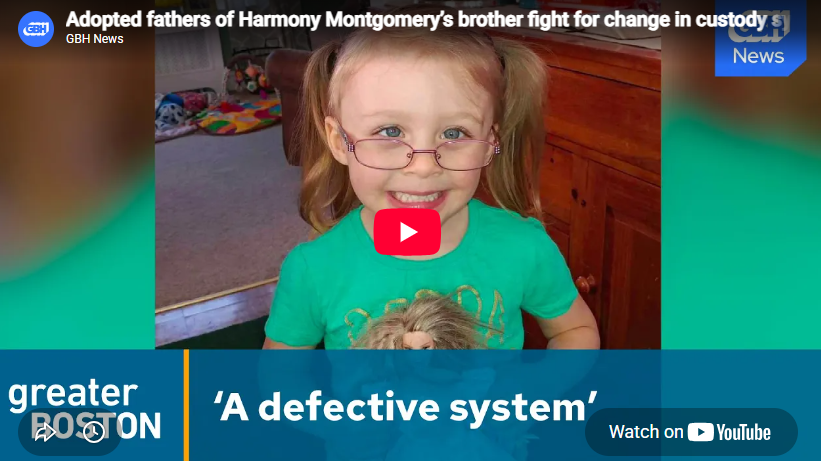
    I whole-heartedly agree with Judge Erskine and appreciate that she’s speaking out. “The system” is defective from entry to exit. It’s harmful, discriminatory, and lacks humanity and compassion. I realize that there are arguments in support of abolishing the system all together. I don’t entirely disagree even though I believe we’re far from not needing some version of a “child protection” system. I hear the arguments against “best interest” representation due to the subjectivity and biases that inform it. However, let me be clear–representation of “expressed wishes” only without some version of best interest advocacy and representation (in and outside the courtroom) jeopardizes the safety and well-being of children. Take it from someone who nobody was paying attention to and suffered the consequences because of it. I’m tired of the lack of humility and compromise in finding solutions that will strengthen families and improve child outcomes. Let’s keep the foot on the gas until we create the change we need!